Estimating guide
How to estimate a drywall job
Drywall looks simple on a plan: some walls, some ceilings. The money is in how many separate things there are. Studs, board, taping and finishing, ceilings, soffits, curved walls, door openings, patching. Price them as one number and you will miss something. Price them as separate lines and you will not.
The example below is a made-up job with realistic figures, so you can see every step. It is not a price list. Use your own rates and your own hours.
1. Split the job into the pieces the work goes in
Framing, boarding, taping and finishing, ceilings, and the odd items. The example job has all of these as lines of their own, and for each floor. Pricing floor by floor also shows you where the money sits.
2. Measure each piece in its own unit
Walls and ceilings by area. Soffits by length. Door openings and backing plates by count. A line only works if its quantity and its unit match, so a soffit is feet, never square feet.
3. Say how long one unit takes
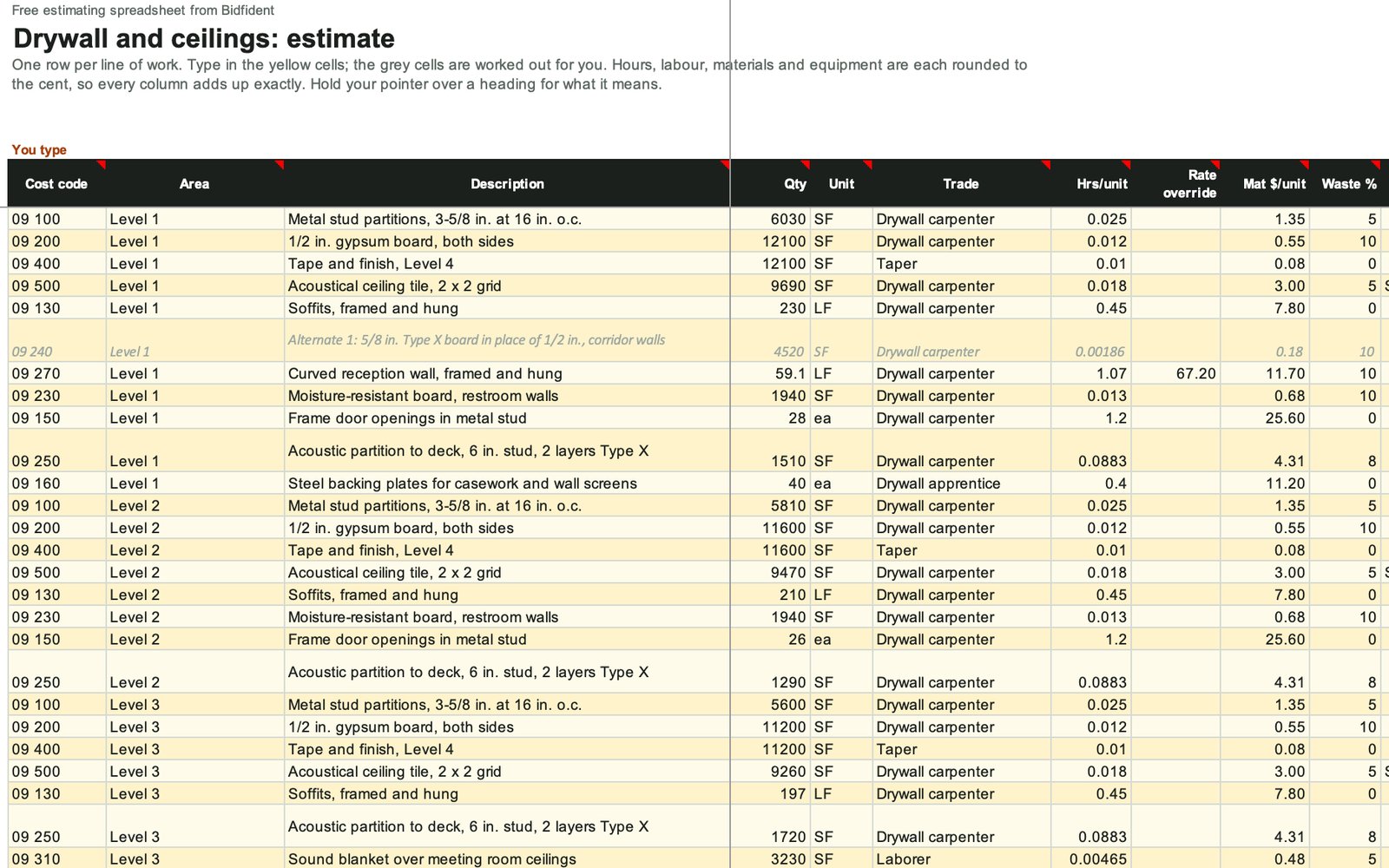
Hours per unit is the number that matters most, and the one nobody can give you. It is yours, from your own crews. In the example, “Metal stud partitions, 3-5/8 in. at 16 in. o.c.” allows 0.025 hours per square foot. A curved wall or a stairwell is different work from a flat office wall, so those get their own lines and their own hours.
4. Add the materials, with waste
Materials are the quantity times the price times one plus waste. Board gets cut and some gets broken, so the example uses 10% on board and 5% on studs. Use what your own jobs show.
5. Add the equipment for the heights
Equipment is priced by the hour and charged to the line that uses it, so the cost is in the line it belongs to. The example has “Scissor lift” and “Rolling scaffold tower”. Ceilings and stairwells need a lift or a tower, and that cost belongs there and not lost in general conditions.
6. Let the packages out, and add your running costs
The example lets out three packages to subcontractors, with up to four quotes each. The lowest is carried unless I pick another, and one package is an allowance because there is no quote yet. Running costs sit apart, and weekly items follow the length of the job, so a longer job costs more. Both lists are under the example.
7. Then contingency, profit and the rest
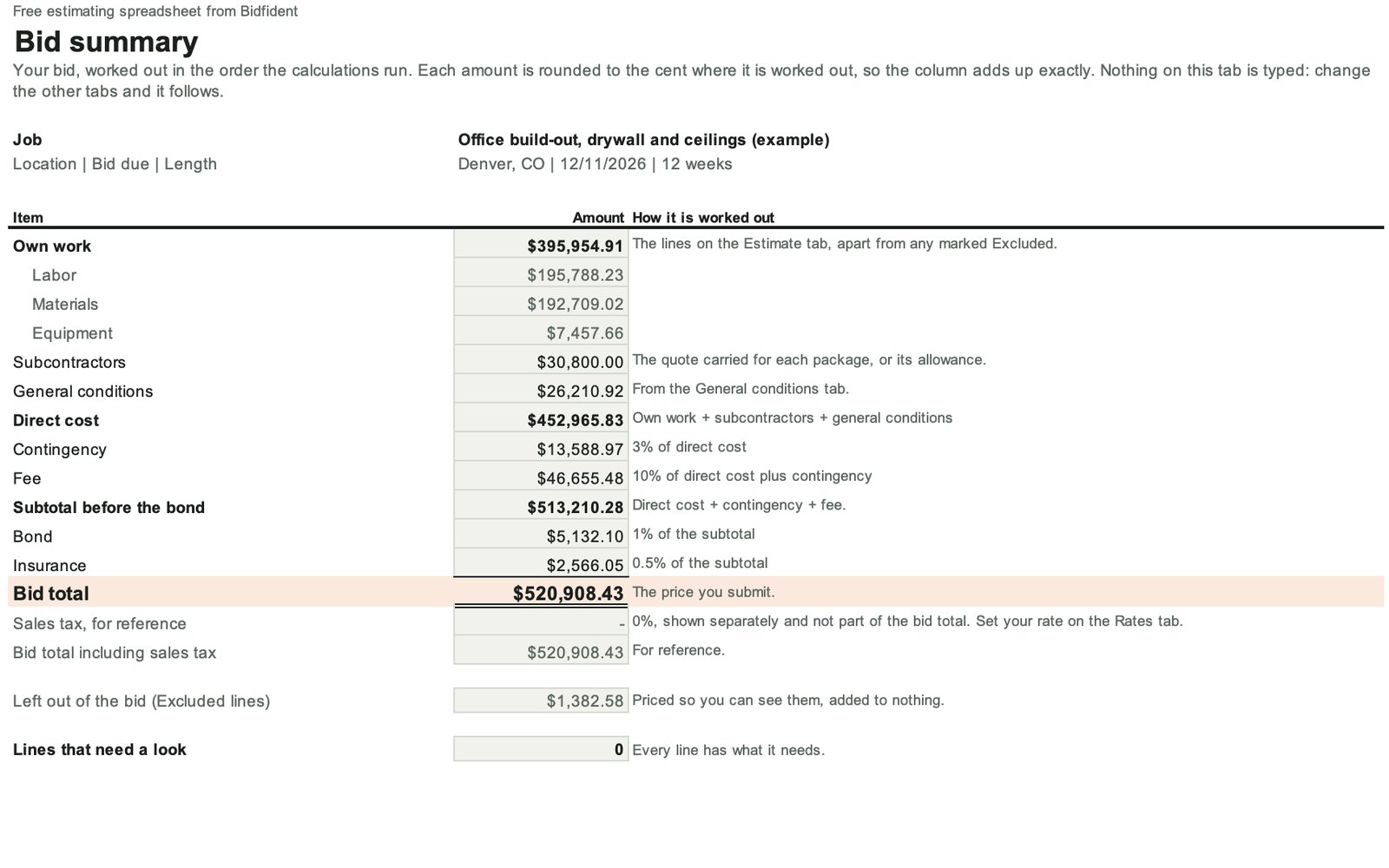
In this order: contingency on the direct cost, then your fee on the direct cost plus contingency, then the bond and insurance on that subtotal. The table below shows each step.
The worked example
The job: drywall and ceilings for a three-story office, Denver, CO. It runs 12 weeks. Every figure here is in the example spreadsheet below.
| Item | Amount |
|---|---|
Hours
| 150.75 hours |
Labor
| $8,743.50 |
Materials
| $8,547.53 |
| Line total | $17,291.03 |
Per square foot
| $2.87 |
Every line of the estimate is worked out like this one. Then the lines are added up, and the rest of the bid is built on top of them.
| Item | Amount |
|---|---|
Own work
| $395,954.91 |
Subcontractors
| $30,800.00 |
General conditions
| $26,210.92 |
Direct cost
| $452,965.83 |
Contingency
| $13,588.97 |
Fee
| $46,655.48 |
| Subtotal | $513,210.28 |
Bond
| $5,132.10 |
Insurance
| $2,566.05 |
| Bid total | $520,908.43 |
Sales tax, shown apart
| $0.00 |
The two lists behind the subcontractors and general conditions lines above:
| Item | Amount |
|---|---|
| Acoustical insulation in partitions | $17,120.00 |
| Firestopping at penetrations and joints | $10,080.00 |
| Stairwell scaffold, allowance | $3,600.00 |
| Total | $30,800.00 |
| Item | Amount |
|---|---|
| Supervision, part-time foreman | $13,200.00 |
| Project manager, part time | $5,316.92 |
| Small tools, screw guns and stilts | $1,824.00 |
| Board delivery and boom truck stocking | $2,720.00 |
| Dumpster swaps | $3,150.00 |
| Total | $26,210.92 |
Common mistakes
- Ceilings at height with no lift hours. The cost turns up on site, not in the bid.
- Nothing for patching and clean-up. The example has a lump sum for patching and repair after other trades, and a daily clean-up line. Both are real work.
- Options inside the price. The example prices its alternate (for example a heavier board in the corridors) with the line marked Excluded. You see the figure, and it adds to nothing until the customer asks for it. That left out $1,382.58 in this example.
- Taping and finishing priced as part of boarding. In the example it is its own line with its own trade and its own hours.
Free estimating spreadsheet
Drywall and ceilings estimate spreadsheet for Excel
The worked example on this page, as an Excel workbook you can make your own: type your rates, your lines and your subcontractor quotes, and formulas work out the bid summary and a one-page quote, to the cent.
Download the example spreadsheet Download a blank spreadsheet
The example has a whole job filled in, ready to change into your own. The blank one starts empty.
Same totals as Bidfident, to the cent. Version 0.1, October 2026.
Filled one in already? Import lines in Bidfident brings in the lines from its Estimate tab.
No sign-up, no email. Free for your own bids. Check every figure before you send a bid. Please don't resell it. All free estimate spreadsheets for the US
Starter cost codes: Drywall and ceilings 36 codes
Bidfident's own starter codes, ready to change into your own. To bring them in, go to Libraries, then Cost codes, then Import from Excel in Bidfident, and pick the file. You see a preview before anything changes. Version 0.1, October 2026.
Free to use for your own bids. Change it to suit your business. Please don't resell it or hand it out as your own list. All starter cost-code lists for the US
When your spreadsheet gets heavy
If you end up with lots of bids, changing rates or more than one person working on them, Bidfident does the same sums on a page and keeps every bid with its saved versions.
Enter your email and Bidfident sends you a sign-in link. New companies start with a starter rate library. Who runs Bidfident, and what it keeps about you.